
Table of Contents
- The Secret Behind Perfect Tofu: Choosing the Right Coagulant
- What Is a Tofu Coagulant?
- Main Coagulants Used for Tofu
- What does Nigari do?
- The problem in Nepal
- What If Nigari Is Not Available in Nepal?
- Our Most Important Ingredient: The Soybean
- How We Should Make Premium Tofu
- The Himalaya Tofu Quality Philosophy
- Our Coagulant Decision Guide
- The Final Answer: What Is the Best Coagulant?
- GDL
- From Nepali Soybeans to Premium Nepali Tofu
- Frequently Asked Questions (F&Q)
The Secret Behind Perfect Tofu: Choosing the Right Coagulant
A practical guide to premium tofu manufacturing from Himalaya Tofu Pvt. Ltd., Baglung, Nepal
Tofu looks simple: soybeans, water and a coagulant. But producing excellent tofu consistently is a science.
Table of Contents
The same soybean milk can produce tofu that is soft, firm, crumbly, smooth, watery, bitter, flavourful or almost tasteless—simply because the coagulant, dosage, temperature, soybean quality and processing method are different.
At Himalaya Tofu Pvt. Ltd., Baglung, Nepal, our objective is not simply to manufacture tofu. Our goal is to produce tofu that customers can recognize for its clean taste, pleasant texture, freshness, nutritional value and consistent quality.
Scientific research confirms that coagulant selection has a major effect on tofu’s water retention, firmness, yield, texture, flavour and even protein-digestion characteristics.
What Is a Tofu Coagulant?
After soaking and grinding soybeans, we obtain soybean milk. When this milk is heated and a suitable food-grade coagulant is added, soybean proteins come together and form a curd. The curd is then separated from the soybean whey and pressed into tofu.
In simple words:
Soybeans → Soaking → Grinding → Soy Milk → Heating → Coagulation → Curd → Pressing → Tofu
The coagulant is therefore one of the most important ingredients in tofu manufacturing.
It does not merely “make the tofu solid.” It determines how the soybean proteins join together and how much water remains inside the final tofu.
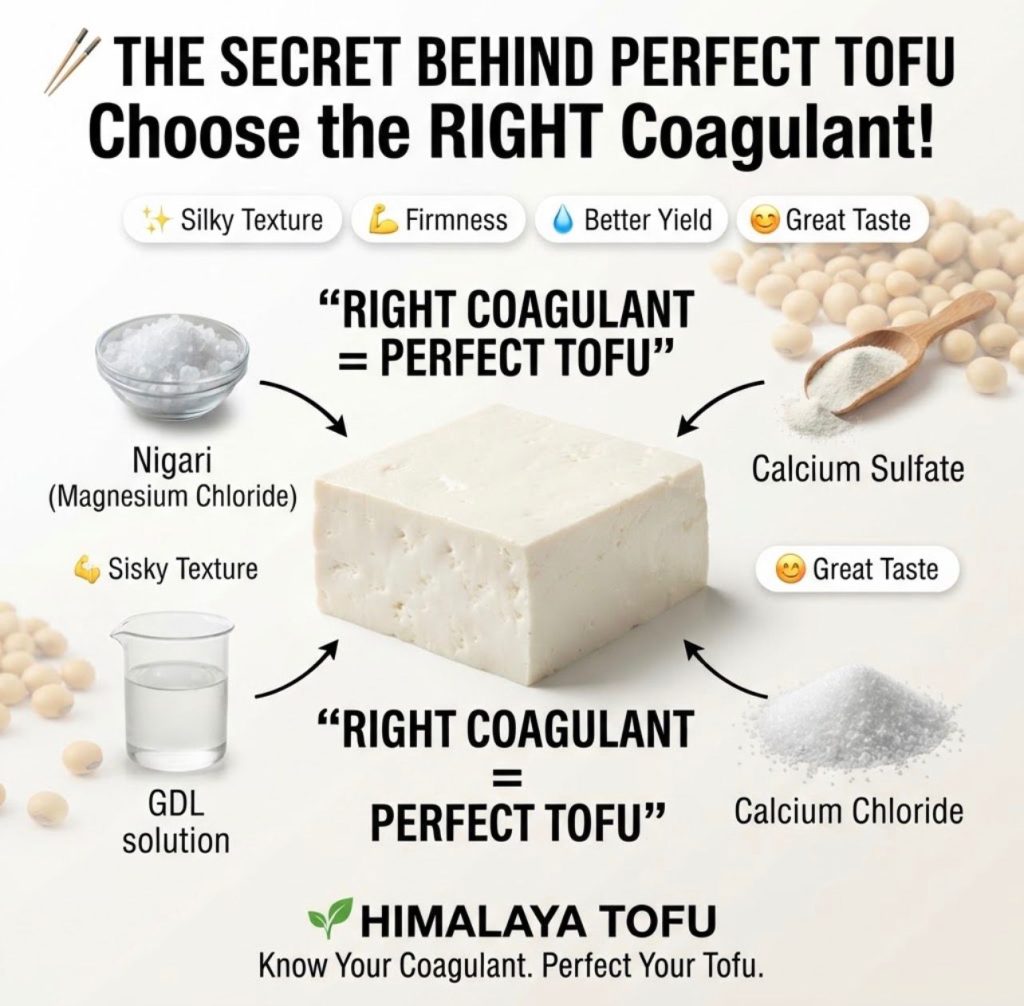
Main Coagulants Used for Tofu
Several coagulants can be used in tofu production. The most important ones are:
- Magnesium chloride (MgCl₂) – Nigari
- Calcium sulfate (CaSO₄) – Gypsum
- Citric Acid -Food Grade
- Glucono-delta-lactone (GDL)
- Calcium chloride (CaCl₂)
- Magnesium sulfate (MgSO₄)
- Calcium lactate / calcium gluconate and other food-grade calcium salts
- Food-grade edible acids such as vinegar or citric acid for particular applications
Codex material on soybean curd lists calcium chloride, magnesium chloride, calcium sulfate, magnesium sulfate and GDL among coagulant/firming agents for soybean curd, subject to good manufacturing practice.
However, not every coagulant is equally suitable for producing the same type of tofu.
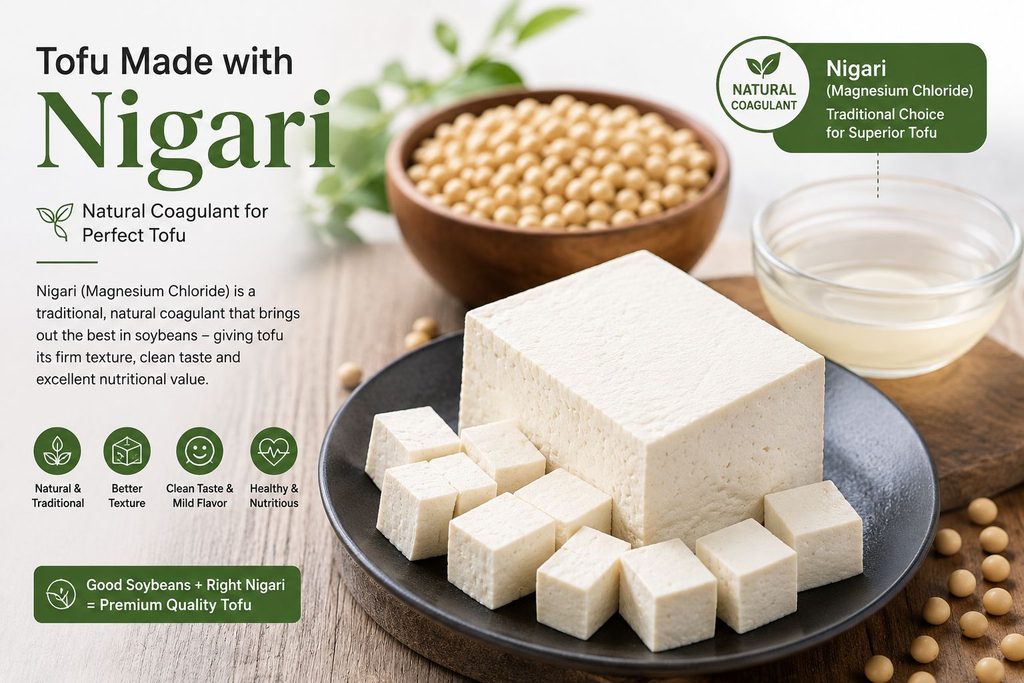
1. Magnesium Chloride – Nigari
Nigari is traditionally associated with Japanese tofu making. It is primarily magnesium chloride and is traditionally obtained from seawater after sodium chloride is removed and the remaining mineral-rich liquid is concentrated.
What does Nigari do?
Magnesium ions interact with soybean proteins and encourage them to form a protein network.
Nigari can produce tofu with:
- A distinctive soybean flavour
- Firm and defined curds
- Pleasant mouthfeel
- Traditional tofu characteristics
However, magnesium chloride works relatively quickly. Too much can produce a stronger or bitter/salty mineral taste and can make the curd harder or less uniform. Research has also found that MgCl₂ tofu can have distinctive textural properties compared with calcium-sulfate or GDL tofu.
The problem in Nepal
For manufacturers in Nepal, high-quality food-grade Nigari may not always be easily available or consistently supplied.
That raises an important question:
If Nigari is unavailable, what should a tofu manufacturer use?
The answer is not to compromise the quality of the product by using an unknown substitute.
2. Calcium Sulfate – The Most Practical Nigari Alternative
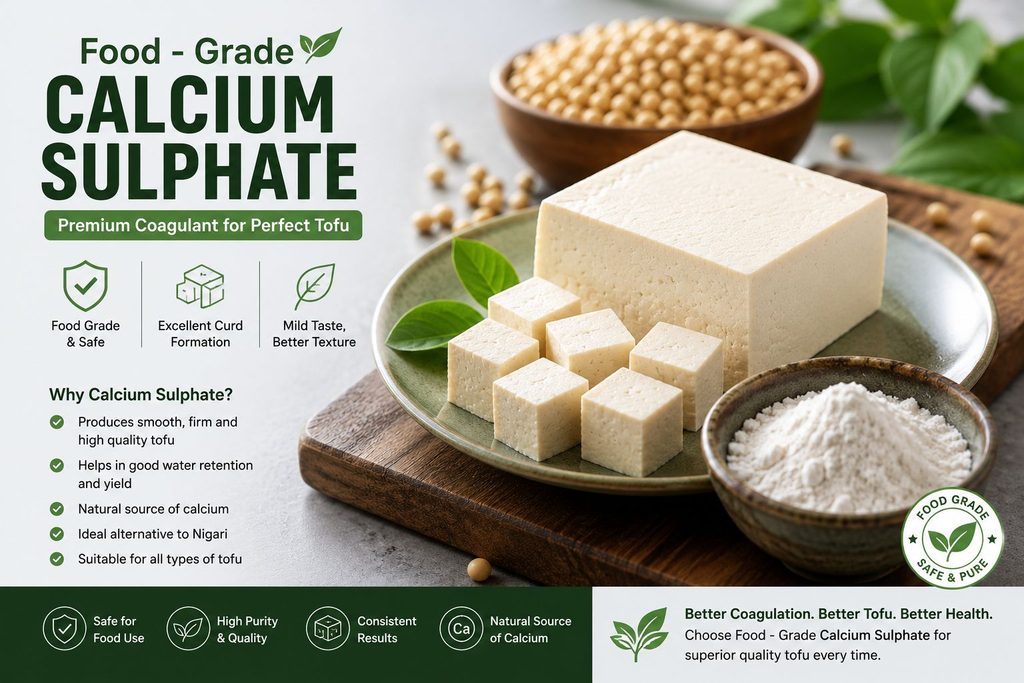
For commercial tofu manufacturing, food-grade calcium sulfate (CaSO₄), commonly called gypsum, is one of the best practical alternatives to Nigari.
Calcium sulfate is one of the oldest and most widely used tofu coagulants. Its relatively low solubility allows coagulation to proceed more gradually, which can help produce a fine and uniform curd.
Advantages
Calcium sulfate can provide:
- Mild flavour
- Good tofu structure
- Smooth texture
- Good firmness
- Additional calcium in the finished tofu
- Good suitability for commercial tofu production
Research comparing different coagulants found that calcium-sulfate tofu can have a fine, smooth structure and that it performed strongly in sensory acceptance in one comparative study.
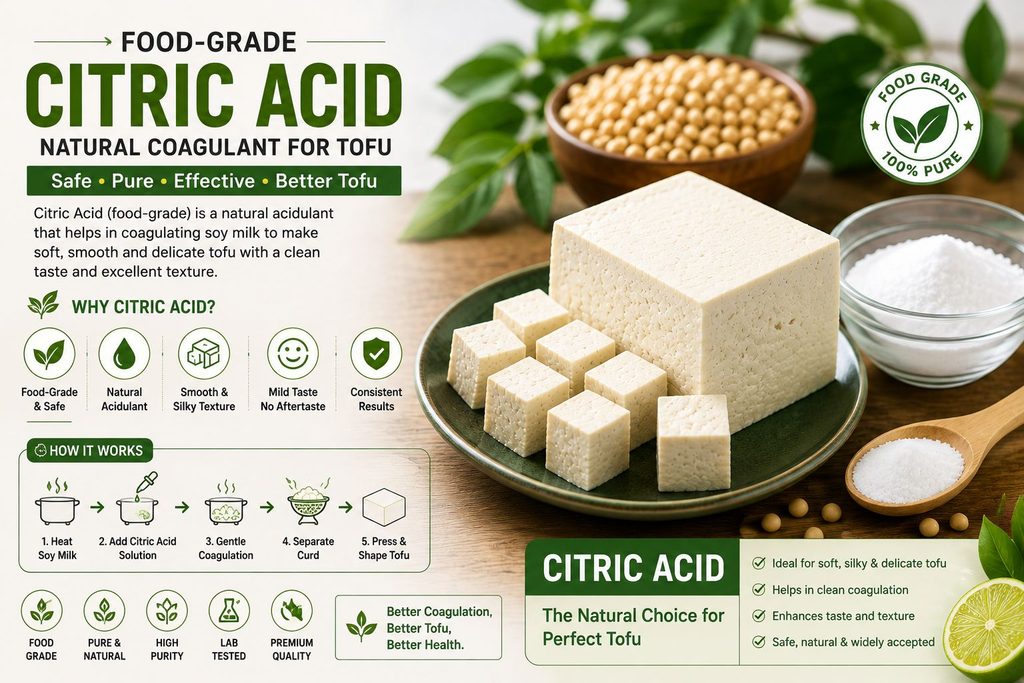
Citric Acid Food – Grade
Food-grade citric acid is an easily available and affordable coagulant in Nepal. It helps soy milk form tofu curds by lowering its pH, making it a practical option for home and small-scale tofu manufacturing.
For Nepal
If quality Nigari is unavailable, food-grade calcium sulfate is a strong first-choice alternative for firm or regular tofu, provided the formulation is properly standardized.
Importantly, the material must be food-grade and suitable for food manufacturing. Industrial, construction or agricultural-grade gypsum should never simply be assumed to be suitable for food.
3. GDL – Glucono-Delta-Lactone
GDL is another important tofu coagulant.
Unlike magnesium or calcium salts, GDL works by gradually producing acidity in the soybean milk. This produces a very fine and smooth protein gel.
GDL is particularly useful for:
- Silken tofu
- Soft tofu
- Smooth tofu
- Delicate textures
- Products where a uniform gel is desired
Studies have found that GDL tofu can have high water-holding capacity and a particularly smooth, uniform protein network.
However, GDL is not automatically the best choice for every firm tofu product.
If our goal is a firm, sliceable tofu for everyday Nepali cooking, calcium sulfate or magnesium chloride may be more appropriate depending on the desired texture.
4. Calcium Chloride
Calcium chloride is another recognized tofu coagulant.
It is highly soluble and can coagulate soybean proteins effectively. Research shows that different calcium salts can produce significantly different yields and textures.
It can therefore be useful when a manufacturer needs another food-grade calcium-based option.
But again, more soluble does not necessarily mean better.
The exact concentration, soybean milk solids, temperature and addition method must be standardized.
5. Magnesium Sulfate
Magnesium sulfate is another magnesium-based salt that can coagulate soybean proteins.
However, it should not be confused with ordinary household or bath products.
For commercial tofu manufacturing, only a verified food-grade ingredient with appropriate specifications should be considered.
The principle is simple:
Never select a coagulant only because it is chemically similar. Select it because it is food-grade, traceable, suitable for the intended application and validated in your tofu process.
So, Which Coagulant Should Himalaya Tofu Use?
This is perhaps the most important question.
There is no single coagulant that makes every type of tofu “the best.”
The best coagulant depends on the product we want to manufacture.
For regular firm tofu
Our practical priority would be:
1. Food-grade Nigari / Magnesium Chloride
when a reliable, standardized supply is available.
2. Food-grade Calcium Sulfate
as an excellent practical alternative when Nigari is difficult to obtain.
3. Carefully validated blends
of compatible food-grade coagulants may be considered when product testing demonstrates better texture, yield and consumer acceptance.
Recent research has shown that combining calcium sulfate and magnesium chloride can improve certain physical characteristics such as water-holding capacity and firmness compared with either coagulant alone.
But this does not mean that every manufacturer should blindly mix them. The exact formulation must be established through controlled trials.
What If Nigari Is Not Available in Nepal?
For a Nepalese tofu manufacturer, our recommendation is straightforward:
Do not wait for Nigari if a consistent supply is difficult.
Instead, develop a standardized calcium-sulfate tofu formulation using verified food-grade calcium sulfate.
This gives the manufacturer a much more reliable production system.
The important point is not simply the name of the coagulant.
It is:
Soybean quality + soy milk concentration + heating + coagulant purity + dosage + temperature + mixing + setting time + pressing + hygiene
All of these work together.
A perfect coagulant cannot rescue poor-quality soybean milk.
Our Most Important Ingredient: The Soybean
At Himalaya Tofu Pvt. Ltd., we have carried out our own practical production experiments with different soybeans.
Our observation has been that Nepal-grown soybeans can produce tofu with excellent taste and desirable tofu characteristics.
In our experience, Nepali soybeans have given us particularly good results compared with some hybrid and imported soybean varieties that we have tested.
However, this is our production observation, not a claim that every Nepali soybean is scientifically superior to every imported soybean.
Soybean quality can vary enormously according to:
- Variety
- Protein content
- Oil content
- Growing conditions
- Harvesting
- Storage
- Age of beans
- Moisture
- Damage and contamination
Therefore, we believe the right approach is to test and standardize the raw material rather than judge beans only by their origin.
How We Should Make Premium Tofu
A premium tofu manufacturer should control the complete process.
1. Select good soybeans
Clean, mature, properly stored soybeans are essential.
2. Soak correctly
Soaking must be controlled because inadequate or excessive soaking can affect grinding, extraction and final tofu quality.
3. Grind efficiently
The objective is to extract as much desirable soybean protein and solids as practical while maintaining consistent processing.
4. Filter properly
Clean filtration produces smoother soybean milk and removes unwanted coarse particles.
5. Heat thoroughly
Proper heating is essential because soybean proteins need to undergo the appropriate structural changes before coagulation.
6. Standardize soybean milk
This is extremely important.
The manufacturer should monitor solids/protein concentration rather than adding a fixed quantity of coagulant blindly every day.
7. Add coagulant consistently
The coagulant should be properly measured and distributed uniformly.
“A little more coagulant” does not mean “better tofu.”
Too much can negatively affect taste and texture.
8. Allow proper setting
The curd needs sufficient time to develop its structure.
9. Press according to the product
The pressing pressure and duration determine whether the tofu becomes soft, medium or firm.
10. Pack and maintain hygiene
Tofu is a high-moisture food, so sanitation, water quality, temperature control, packaging and storage are essential for protecting freshness and food safety.
The Himalaya Tofu Quality Philosophy
At Himalaya Tofu Pvt. Ltd., Baglung, Nepal, our goal should not be:
“How can we make tofu as cheaply as possible?”
Our goal should be:
“How can we make the best tofu consistently, safely and honestly for our customers?”
That means we should never select a chemical merely because it is cheap.
We should select:
Food-grade → Safe → Consistent → Tested → Suitable → Traceable
The same principle applies to soybeans.
We should not simply say “Nepali soybean is best.”
We should prove quality through:
- Consistent batches
- Taste testing
- Texture testing
- Yield monitoring
- Moisture control
- Protein/solids monitoring
- Microbiological safety
- Proper packaging
- Customer feedback
That is how a local tofu company can build a premium national brand.
Our Coagulant Decision Guide
| Desired product | Preferred option | Practical alternative |
| Traditional firm tofu | Magnesium chloride/Nigari | Calcium sulfate |
| Regular firm tofu | Calcium sulfate or MgCl₂ | Validated combination |
| Soft/silken tofu | GDL | Carefully formulated alternatives |
| Smooth premium tofu | Calcium sulfate/MgCl₂ depending on target | Validated blend |
| When Nigari is unavailable | Food-grade calcium sulfate | GDL for suitable soft-tofu products |
| Experimental formulation | MgCl₂ + CaSO₄ | Must be tested and standardized |
Research supports the idea that coagulants produce different textures, water retention and digestibility characteristics, so the choice should be based on the product specification rather than a one-size-fits-all approach.
The Final Answer: What Is the Best Coagulant?
If we had to give a simple answer for Himalaya Tofu’s commercial manufacturing in Nepal, it would be:
🥇
Food-grade Magnesium Chloride/Nigari
Excellent choice when reliable, consistent-quality Nigari is available.
🥈
Food-grade Calcium Sulfate
Our most practical alternative when Nigari is difficult to obtain in Nepal—and an excellent choice for regular firm tofu.
🥉
GDL
Excellent for smooth, soft and silken-style tofu rather than automatically replacing Nigari in every product.
And the most important lesson is this:
The best tofu does not come from the coagulant alone. It comes from the right soybean, clean water, controlled processing, the correct coagulant, accurate dosage, proper temperature, good pressing and strict hygiene.
From Nepali Soybeans to Premium Nepali Tofu
Himalaya Tofu Pvt. Ltd. has an opportunity to build something bigger than another tofu product.
We can build a trusted Nepali tofu brand based on local raw materials, careful experimentation, modern food-processing practices and uncompromising quality.
Our production experience has shown us that Nepali soybeans can produce exceptionally good tofu, and our continuing responsibility is to identify the varieties and processing conditions that consistently deliver the best results.
Because ultimately, customers do not buy tofu because of the name of the coagulant.
They buy it because:
It tastes good.
It feels right.
It is fresh.
It is nutritious.
It is safe.
It cooks well.
And they trust the brand.
Frequently Asked Questions (F&Q)
Which coagulant is best for tofu?
Nigari is excellent for traditional firm tofu, while food-grade calcium sulphate is a greater alternatives.
Is Calcium sulphate good when Nigari isn’t available
Yes, Its is a practical choice for producing smooth, firm and mild-testing tofu.
Does coagulant affect tofu quality?
Absolutely! It affects taste, texture, firmness, yield and water retention.
Why use Nepal soyabeans?
Our experiments show that quality Nepali soyabeans cxan produce excellent-testing high-quality tofu.
What makes Himalaya Tofu special?
Quality soyabeans + food-grade coagulant + hygienic processing = better tofu and customer trust.
Himalaya Tofu Pvt. Ltd. — Quality begins with the soybean and continues through every step of production.
Technical note: Coagulant quantities should not be copied from a generic article as a manufacturing recipe. Commercial production should establish the exact dosage and process through controlled batch trials using the specific soybean variety, soy-milk concentration and food-grade coagulant, while complying with applicable Nepal food-safety requirements.